Termination Due to Retrenchment
Termination Due to Retrenchment


When your business falls on hard times, you can validly terminate for authorized causes.
Business reverses happen to everyone. If these become severe enough, an employer may have to consider retrenching employees. But for legal as well as economic reasons, this is not a decision to be made lightly.
Retrenchment in the Philippines is covered by Art 297 (formerly 282) of the Labor Code, the issuances of the Department of Labor, and the decisions of the Supreme Court.
This post should help you understand what retrenchment requires in the Philippine context, its legal grounds, and the correct process to apply.

Send us an email with the details for
personalized recommendations or schedule a consulation if needed.
That’s fairly accurate.
Retrenchment, as defined by the Supreme Court, is:
… an act of the employer of dismissing employees because of losses in the operation of a business, lack of work, and considerable reduction on the volume of his business, a right consistently recognized and affirmed by this Court. [G.R. 181719, Apr 2014]

Due Process for Retrenchment requires a written notice and separation pay.
As an HR practitioner, it’s important that you know the elements required for lawful retrenchment:
- Retrenchment can be availed of if: (1) the losses incurred are substantial and not de minimis; (2) the losses are actual or reasonably imminent; (3) the retrenchment is reasonably necessary and is likely to be effective in preventing the expected losses; and (4) the alleged losses, if already incurred, or the expected imminent losses sought to be forestalled, are proven by sufficient and convincing evidence. [G.R. 187214, Aug 2013]
- the employer exercises its prerogative to retrench in good faith [G.R. 170464, Jul 2010]; and
- the employer uses fair and reasonable criteria in ascertaining who would be retrenched or retained [G.R. 170464, Jul 2010].
That’s a lot of legalese, but it’s really just saying that you must retrench only for valid and serious reasons and that you’re using fair criteria for choosing who stays and who goes.
Simple enough, right?

Mitsubishi finally decided to retrench after several prior attempts at cost cutting
In addition, retrenchment must also follow two further requirements set by law [G.R. 170464, Jul 2010]:
- the employer serves written notice both to the employee/s concerned and the DOLE at least one month before the intended date of retrenchment;
- the employer pays the retrenched employee separation pay in an amount prescribed by the Code.
(An employee is entitled to receive a separation pay equivalent to one-half (1/2) month pay for every year of service, a fraction of at least six (6) months being considered as one (1) whole year)
To stop the losses, it implemented many cost-cutting measures.
It tried to reduce office supplies use, deferred project implementation, froze hiring, and implemented a 5% cut in managerial salaries among others.
Finally, it decided it would need to permanently retrench.

You’ll need a set of criteria uniformly applied to dismiss fairly.
When this was challenged, the Supreme Court upheld the decision in favor of Mitsubishi.
It pointed to all the proof Mistubishi submitted to show that there was a real reason for retrenchment. [G.R. 169780, Feb 2009]
When retrenchment is done for real, pressing reasons and the proof is brought to Court, you present a strong case that protects your company well.
It is a good idea to have a list of criteria and evaluate each employee based on their merits.
This way, decisions are held to be fair and not motivated by personal considerations.

You’ll need a set of criteria uniformly applied to dismiss fairly.
Fair and reasonable criteria need to be proved to the Court whenever a retrenchment case is brought before them.
Without this, the Court may hold the retrenchment invalid. [G.R. 178083, Oct 2009]
I’ve compiled a list of common situations (not exhaustive!) so as to better show through example what retrenchment is.

Want to see if your situation is similar? Check the brief list of examples below.
1. Reduction in the volume of work
When a Saudi Aramco contract was reduced by 40%, the Supreme Court upheld that retrenchment was valid. [G.R. 163657, Apr 2012]
2. Retrenchment of workers to prevent anticipated or actual losses.
During the economic downturn, TP Cement was dissolved and its sister company moved from production to marketing Thai based products due to substantial losses. The dismissal was valid. [G.R. 20149138, Feb 2006]
3. Closure of a department or section
Waterfront closed down its casino division but kept the hotel division open as it sustained losses of USD 3.5M. Although employees filed for illegal dismissal, the Court sided with the company. [G.R. 174214, Jen 2012]
4. Reorganization of the company
When Plastimer reorganized, it required the termination of employees to stave off further losses. The Court upheld the dismissals. [G.R. 183390, Feb 2011]
There are others, but this serves as a good place to start and hopefully makes it easier for you to understand what “retrenchment” means in practice.
They are similar, but the Court defines them differently.

Redundancy and retrenchment are often confused but are different from each other.
I’ve summarized from Jardine [G.R. 181719, Apr 2014]:
- Redundancy is when the services of an employee are in excess of what is needed. It can occur even when the business is doing well if labor is in excess of what the company requires.
- Retrenchment is when there are losses in the operation of the business.
Another important distinction is that the separation pay awarded to employees is different.
- Separation pay for redundancy is equivalent to the employee’s one-month pay for every year of service, a fraction of at least six (6) months being considered as one whole year.
- Separation pay for retrenchment is equivalent to one-half (1/2) month pay for every year of service, a fraction of at least six (6) months being considered as one (1) whole year, if his/her separation from
Thus, aside from a purely legal distinction, the economic effects on the company are different and significantly affect the bottom line.

Follow due process!
Remember back up top, when I defined retrenchment?
Aside from the legal definition, I listed 5 items.
There was good faith, fair and reasonable criteria, and a definition of the kind of loss that is termed “retrenchment”.
I also mentioned two other requirements:
- 30-day notice to DOLE and the employee
- Separation pay of 1 month or ½ month for every year of service, whichever is higher. A fraction of at least 6 months is considered a year.
The calculation is really simple.
It’s just years of service multiplied by the employee’s compensation.
So it is:
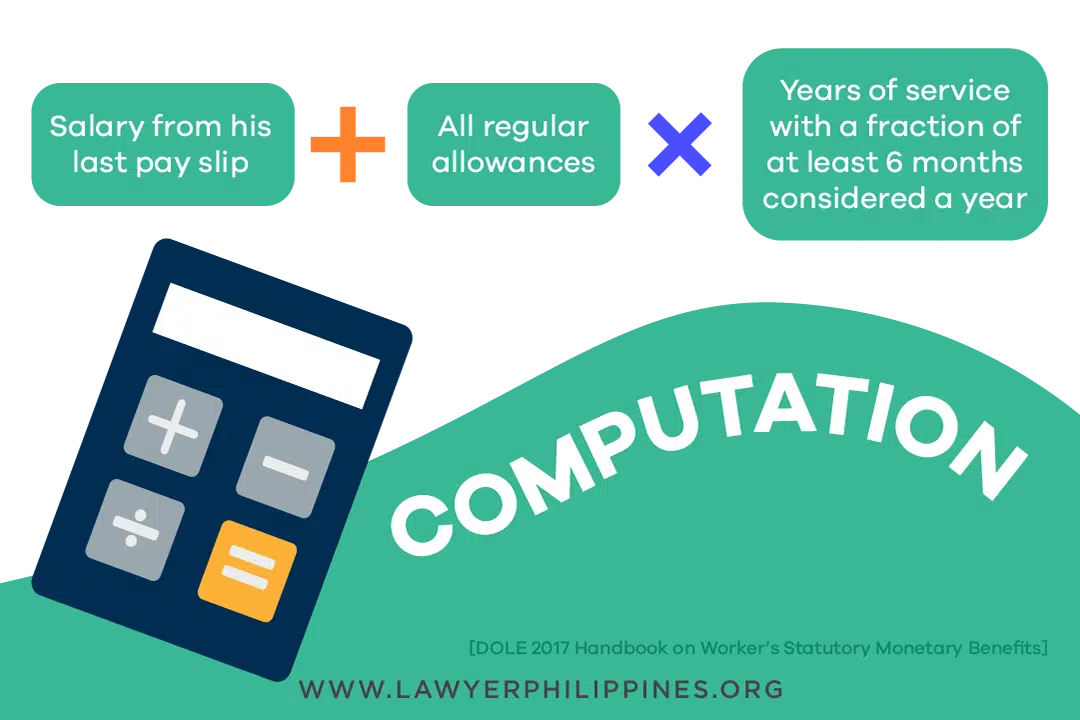
Salary from his last pay slip
Plus all regular allowances
Multiplied by Years of service with a fraction of at least 6 months considered a year.
[DOLE 2017 Handbook on Worker’s Statutory Monetary Benefits]
Oh, and note that separation pay is not taxed, as per law.
The 30-day notice is equally simple.
You’ll need to fill out the DOLE form (RKS Form 5) and inform them and the affected employees at least 30 days in advance.
So, if you are contemplating retrenchment remember what we’ve gone through.
Retrenchment, by its nature, is not an easy decision to undertake, but ensuring you understand what it requires will make it much easier for your company and yourself.