Philippine SEC Business Registration
Philippine SEC Business Registration


Foreign com panies interested in setting up business in the Philippines have 5 options for entry.
- Domestic Corporation
- Branch Office
- Representative Office
- Regional Headquarter
- Regional Operating Headquarters
The right business entity depends on the incorporator’s nationality, the level of liability, ease of incorporation and operation, capitalization, taxes, industry and whether or not the company generates income in the Philippines.
The below post explains these considerations and options in detail.

Send us an email with the details for
personalized recommendations or schedule a consulation if needed.
The Philippines has a growing economy.
It is one of the best performing in the region, with 6% on track for 2024.
It has a large and young population, which is a well-educated English-speaking workforce that has strengths in customer service, programming, digital work among others.
In 2026, growth is expected to be 6.2%.
Due to its position within Asia, its growth projections and its labor force, the Philippines has emerged as a prime spot to do business in the Philippines – in face, recent statistics reveal that over 40,000 businesses were registered in the Philippines in the previous year, reflecting a rising interest from both local and international investors eager to enter the market.
Below, I’ll go over the possible options for incorporating in the Philippines.
Selecting the appropriate business entity is crucial for success. Below is an overview of common business structures available in the Philippines:
• Domestic Corporation is ideal for businesses desiring limited liability and has low capitalization requirements.
• Branch Office has 100% foreign control and is ideal for foreign enterprises aiming to operate directly within the Philippine market. It is an extension of a foreign entity but must still comply with local laws and fulfill tax responsibilities.
• Representative Office is for companies that intend to promote their products or services without generating local income and operates primarily as a liaison in the region.
• Regional Headquarters (RHQ) RHQs enable foreign businesses to oversee operations in Southeast Asia from the Philippines, beneficially without incurring local income tax liabilities. –
• Regional Operating Headquarters (ROHQ) ROHQs are akin to RHQs but allow for the generation of local income under specific guidelines and conditions.
Domestic Corporation

- 100% foreign ownership, subject to the negative list and either USD 200,000 capitalization or USD 100,000 capitalization if hiring 50 people or using advanced technology.
- No minimum capitalization if 60% Filipino owned or 60% of sales are export oriented
- Liability is limited to domestic corporation
- Any line of business
- Required Philippine resident Treasurer and Philippine citizen Corporate Secretary
- Can derive income in the Philippines.

Representative Office
- Liability extends to foreign parent
- USD 30,000 initially and every year thereafter.
- Same line of business as foreign parent
- Must have Philippine resident agent
- No Philippine derived income
- No income taxes, VAT or PEZA/BOI tax incentives

Branch Office
- 100% foreign ownership, subject to the negative list.
- Liability extends to foreign parent
- USD 200,000 initially
- Same line of business as foreign parent
- Must have Philippine resident agent
- Can have Philippine derived income

Regional Headquarters
- 100% foreign ownership, subject to the negative list.
- Liability extends to foreign parent
- USD 50,000 initially and every year thereafter
- Same line of business as foreign parent
- Must have Philippine resident agent
- No Philippine derived income
- No income tax, VAT and offers incentives for foreign personnel.

Regional Operating Headquarters
- 100% foreign ownership, subject to the negative list.
- Liability extends to foreign parent
- USD 200,000 initially
- Same line of business as foreign parent
- Must have Philippine resident agent
- Can have Philippine derived income
- 10% VAT, 10% income tax and branch profit remittance tax.
- Offers available incentives for foreign personnel.
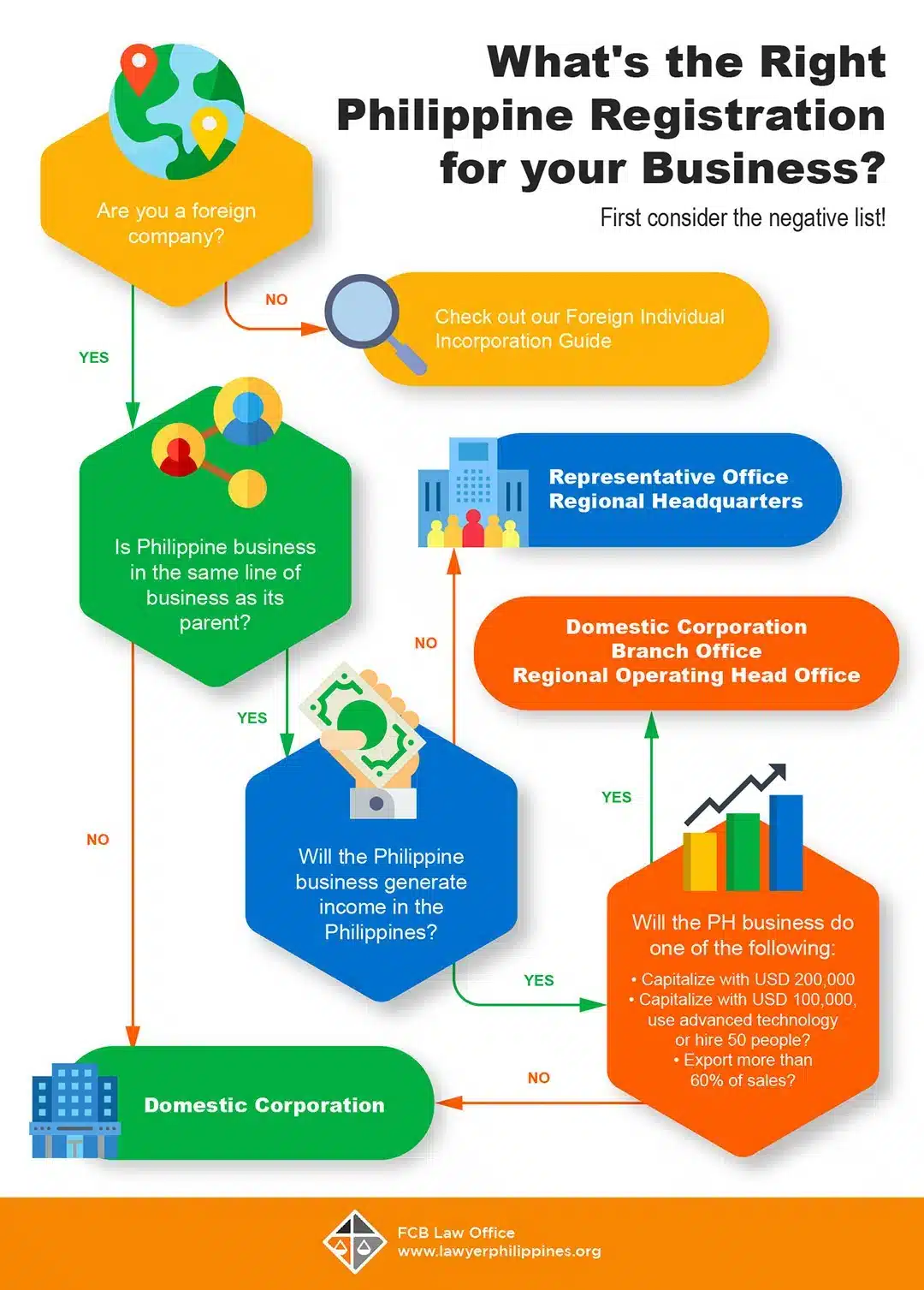
The quick decision tree below helps determine the right structure to use based on a few pertinent questions.
- What are the per industry foreign equity restrictions stated in the latest Negative List?
- Is Philippine business being in the same line of business as its parent?
- Does the Philippine business generate income from the Philippines?
- How much is the Philippine business’s capitalization?
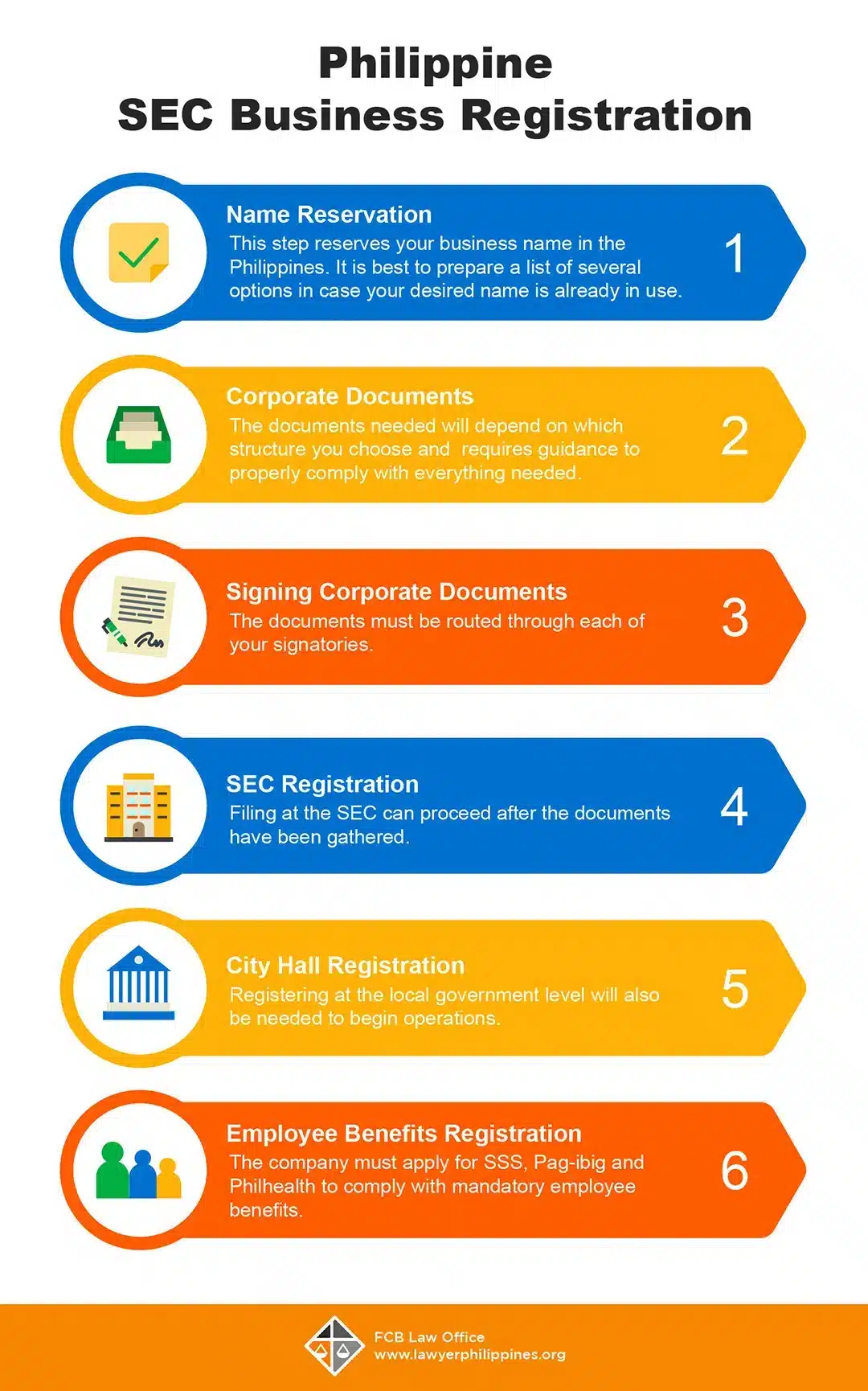
If you’ve already determined the right structure, you might be wondering what the process to register is like.
The usual process is explained below, to give you an idea of the general steps. These steps can take 6 weeks from filing at the SEC.
The process may change should you need endorsements from government bodies that regulate your industry, tax authorities that provide incentives or facts particular to your case.
These factors can affect the time frame.
Required Documents
Documents differ depending on the structure chosen. A list of common documents can be found below, and specific documents can be found in the links for each type of entity.
- Cover Sheet
- Name Verification Sheet
- Application Form
- Authenticated Copy of Board Resolution
- Authenticated Copy of Articles of Incorporation & By Laws
- Financial Statements
- Affidavit the company is of sound financial position/Compliance with Financial Ratios
- Notarized Proof of Inward Remittance
- Treasurer’s Affidavit
- Affidavit of Undertaking (if not stated in the Application Form)
- Resident Agent’s Accaptance of Appointment (if not a signatory in the application)
- Endorsement from Applicable Government Agencies, as applicable
- Endorsement of BOI, as applicable
- Certification that the foreign firm is a multinational from the Philippine embassy & other authorized offices*
- Authenticated Certification from principal officer that the Board has authorized the ROHQ/RHQ*
*for RHQ/ROHQ
Entrepreneurs often encounter hurdles such as grappling with intricate regulations and comprehending compliance mandates that can be overwhelming during the registration process.
Although the steps can be simple, it becomes challenging because of bureaucracy and because there are numerous entities to deal with.
Philippine institutions are quite strict.
Documents have to be prepared precisely and deviations are not welcomed.
Due to this level of detail, it is very advisable to consult with legal counsel and work with them on how to incorporate correctly as well as to assess what business structure actually fits your needs.