Philippine Estate Taxes 2018
Philippine Estate Taxes 2018

This post answers those questions as I explain the current 2018 Philippine TRAIN estate taxes and provide sample computations.

Send us an email with the details for
personalized recommendations or schedule a consulation if needed.
Simply computed, this is:
Gross estate less Allowable Deductions equals
Net Proceeds multiplied by 6%
Seems simple, but the confusion lies in what makes up the gross estate and the allowable deductions.
Add in foreign holdings, dual citizenships, and foreigners and most people are ready to thrown in the towel.
While we don’t go into complicated estate tax issues here – and trust me, every case is different – I try to provide enough information to point you in the right direction.
For non-resident aliens however, gross estate are properties only located in the Philippines and include intangible personal property subject to the rule of reciprocity.
Now, here comes the hard part – how do you value the gross estate?
1 Land. Higher of the Fair Market Value given by the Commissioner or the provincial and city assessors.
2 Stock. As per the stock exchange but if not listed then it is the book value for unlisted common shares and the par value for unlisted preferred shares.
3 Club membership. Most recent bid price near date of death published in a newspaper.
So, now we have half the puzzle.
The definition of these items are a bit more involved and need to be supported by substantial documentation.
Below is a simple summary of the allowed deductions.
There are some restrictions around some of the deductions and the details are best discussed with your lawyer.
- Standard deduction of Php 5,000,000
- Claims against the estate
- Claims the estate might have against insolvent persons
- Unpaid mortgages, taxes or casualty losses not covered by insurance or already claimed in an income tax filing
- Previously taxed inherited property has exceptions at graduated rates if the previous decedent died within 5 years from the decedent in question. Other considerations are also applied.
- Transfers to the Philippine Government for public use
- Value of family home in excess of Php 10,000,000 will be taxed
- Amount received by the heirs from the employer under R.A. 4917 Act Dealing with Retirement Benefits provided that the separation benefit is included as part of the gross estate.
- Net share of the surviving spouse
It’s a shorter list.
- Standard deduction of Php 500,000
- Proportion of indebtedness his Philippine Gross Estate bears in relation to his entire Estate for
- Claims against the estate
- Claims the estate might have against insolvent persons
- Unpaid mortgages, taxes or casualty losses not covered by insurance or already claimed in an income tax filing
- Previously taxed inherited property has exceptions at graduated rates if the previous decedent died within 5 years from the decedent in question. Other considerations are also applied.
- Transfers to the Philippine Government for public use
- Net share of the surviving spouse
So that’s what the law says.
Remember that these are subject to considerations and you’ll have to work out with your accountant and lawyer.
Say your unmarried Filipino uncle has a family home of 30M and other property worth 14M.
He has some unpaid real estate taxes of 2M.
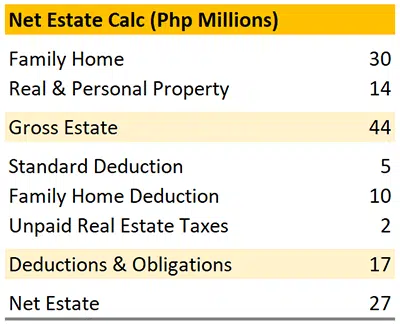
Simple so far.
Just remember that the 10M deduction is only used when for a family home and when that home is 10M and above.
If the family home is less than 10M, then the deduction is only up to the value of the home and not the entire 10M.
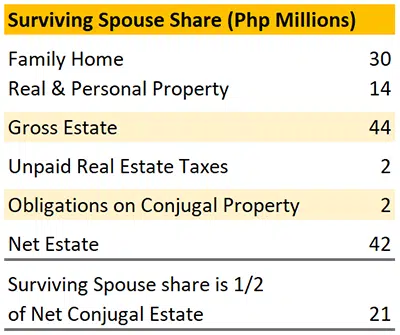
The only difference between this and the above scenario is that there is a surviving spouse.
Based on the law, we need to reduce the estate by the surviving spouse’s portion.
So, below is how we calculate her portion.
Surviving Spouse share:
Estate tax is now calculated as:
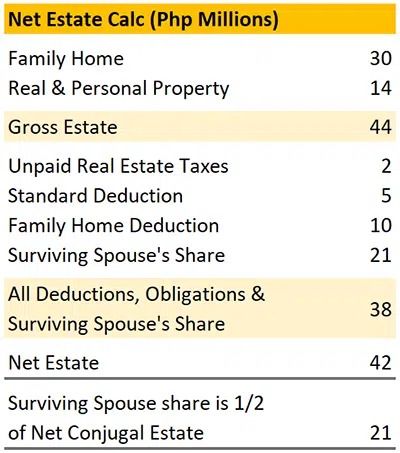
This works when the estate is composed of conjugal property.
If there are exclusive properties, then these have to be excluded from the surviving spouse’s calculation.
Exclusive properties are enumerated by the law and depend on what type of property regime governed at the time of your marriage.