Bigamy in the Philippines: How to End a Bigamous Marriage (Nullity Case), Fix PSA Records, and Avoid Criminal Trouble
Bigamy in the Philippines: How to End a Bigamous Marriage (Nullity Case), Fix PSA Records, and Avoid Criminal Trouble


It is well known that a bigamous marriage is null and void under Philippine law.
If one of the parties to a marriage was already or still married at the time of the second marriage, then that second marriage is null and void.
But here’s the practical problem: even if a second marriage is void, your PSA records can still show “married,” and government offices, banks, and even future marriage applications will usually rely on PSA documents first.
That’s why people often still need to file a court case to end the “on paper” marriage and correct the civil registry.
Below, we discuss bigamy in terms of (1) what the law says, (2) what can trigger criminal exposure, and (3) the step-by-step, practical process to file the right case and update your PSA records.

Send us an email with the details for
personalized recommendations or schedule a consulation if needed.
Bigamous marriages are void and may lead to criminal charges—seek legal advice early.
A bigamous marriage occurs when an individual enters into a marriage with someone while still legally married to another person.
In the Philippines, such a marriage is regarded as null and void.
- A second marriage is generally void from the start if the first marriage still exists.
- There is a narrow exception when the absent spouse is declared presumptively dead by a court under the Family Code rules.
- Bigamy is not just a “family issue.” It can also trigger criminal prosecution under the Revised Penal Code from the court prosecutor assigned to the case by the Solicitor General. That is why it is important to discuss with your lawyer so that you can determine how to file the case to reduce that risk.
Action: Write down a simple timeline: (1) first marriage date/place, (2) second marriage date/place, (3) whether any court case (nullity/annulment/presumptive death) happened before the second marriage.

Void marriages still need court action to fix PSA records and avoid legal complications.
Yes—often, you still need a court case so the nullity of the marriage is officially recognized and your records can be corrected. The Family Code treats bigamous marriages as void.
Also, Philippine law requires a judicial declaration of nullity for purposes of remarrying and for relying on the marriage’s nullity in official transactions.
- Even if you “know” the marriage is void, PSA and LCR records may continue to show a marriage exists until properly annotated.
- Property, inheritance planning, benefit claims, and even new relationships can become legally messy if the civil registry is not fixed.
- If your situation involves multiple marriages, you should expect that government offices will ask for PSA documents that reflect the corrected status.
Action: Secure a PSA copy of the marriage certificate(s) involved and keep them in a single folder (physical + scanned), ready for review.
One-line help: If you want a lawyer to evaluate your exposure and the fastest legal path, email admin@lawyerphilippines.org.

Bigamy cases hinge on facts, proof, and court ruling. Consult your lawyer before filing.
In a regular annulment proceeding, the criminal case for bigamy can be levied against one of the spouses by the government appointed prosecutor assigned to the case.
A government appointed prosecutor is a different lawyer and is not your lawyer; it is someone that the government assigns to all annulment cases.
However, being charged with bigamy does not occur in all cases, and it is important to understand the legal basis and recent cases so that you understand the perspective that the law has on this.
The legal basis for bigamy is Article 349 of the Revised Penal Code and is when a person contracts a second or subsequent marriage while the first marriage has not been legally dissolved (or before the absent spouse is declared presumptively dead).
However, recent Supreme Court discussions have clarified that void marriages may matter in a criminal bigamy case, and the defense may raise the void nature of the marriage in certain situations.
- Do not assume that “invalid first marriage” automatically protects you—criminal cases depend on specific facts and proof.
- If your spouse was missing, do not rely on rumors or “matagal na siyang wala.” The Family Code has rules on presumptive death that generally require a court process before a subsequent marriage is treated as valid.
- If there are identity issues (alias names, late registration, multiple records), your strategy and evidence must be planned carefully.
- If you are filing an annulment case based on bigamy, it is be possible to so, but you will need to discuss carefully with your lawyer to plan it out exactly.
Action: If you are worried about a bigamy charge, talk to a lawyer collect your documents first—especially PSA copies and anything showing dates and identities.
One-line help: Bigamy risk is fact-sensitive—if you want a lawyer to assess criminal exposure and civil options, email admin@lawyerphilippines.org.

Bigamy brings criminal risks!
Participating in a bigamous marriage can result in serious legal consequences:
- Criminal exposure: A person who contracts a second marriage while still married may be prosecuted for bigamy under Article 349.
- Civil nullity: The second marriage is void under the Family Code if contracted while a prior marriage exists (subject to limited exceptions).
- Paper problems become real problems: Even if the marriage is void, PSA records can still cause issues in property transactions, benefits, and future marriages until corrected.
Action: Make a list of immediate “risk areas” you need to protect today (kids’ documents, property titles, benefits, visa/immigration filings, bank records) so your lawyer can prioritize what matters.

Nullity cases require strict proof of residency—wrong venue risks delay or dismissal.
A case for declaration of nullity of marriage is filed in the Family Court/RTC branch designated to handle family cases, following venue and residency rules. Philippine courts can be strict about residency and proof of address.
- Expect to prove residency using barangay certification/sketch and other documents such as utility bills or bank statements with your address on it.
- Filing in the wrong place can lead to delay or dismissal, which costs time and money.
- If a party is abroad or left the home for just cause, the rules can be different, but documentation still matters.
Action: Gather proof of address for the last 6 months (utility bills, lease, IDs, barangay certificate with sketch) before your first lawyer meeting.
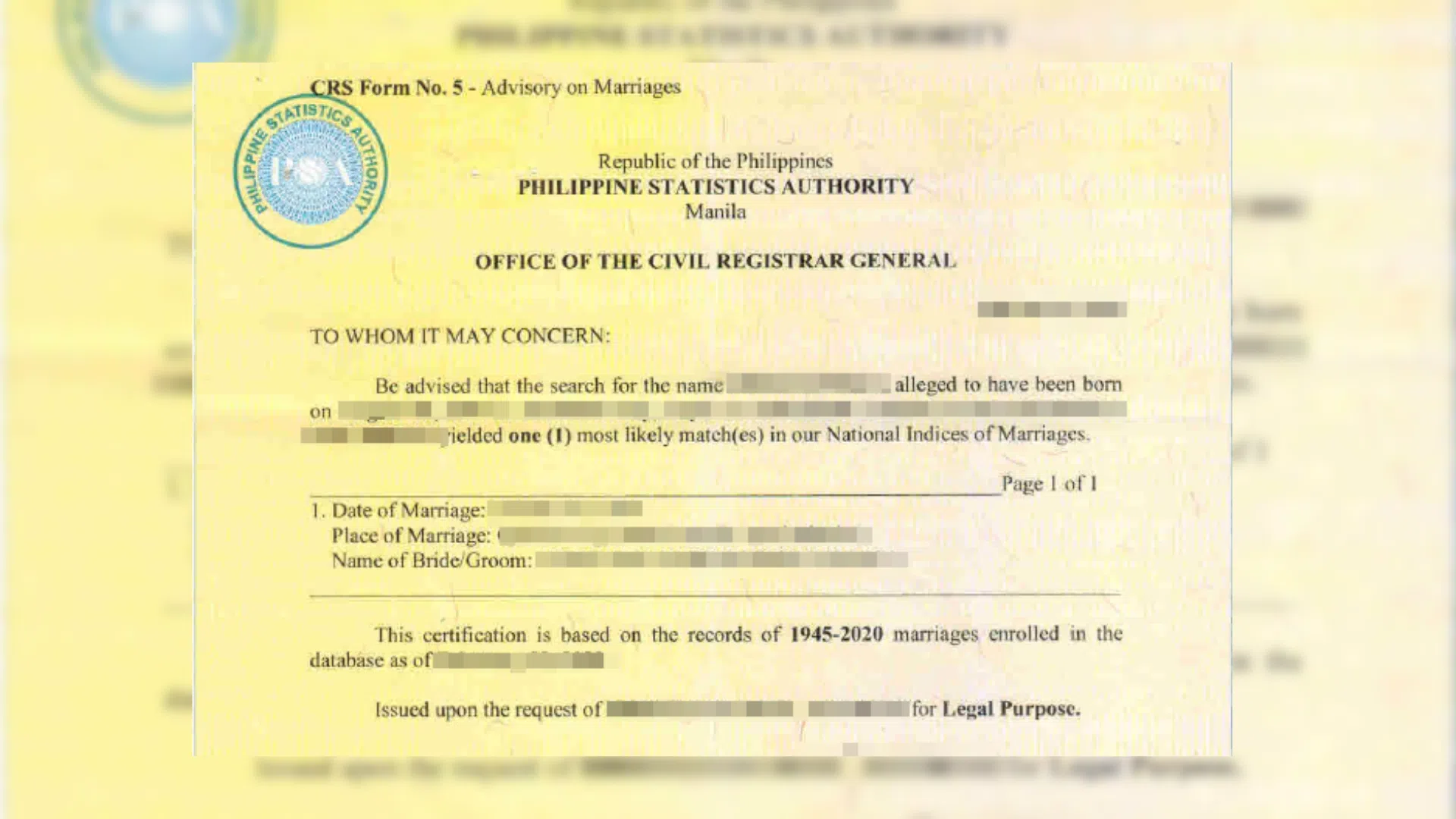
Advisory on Marriage verifies PSA?recorded marriages, vital for licenses, records, and legal proof.
First among them is gathering the evidence that will be needed.
These include obtaining an Advisory on Marriages from the Philippine Statistics Authority (commonly used to show recorded marriages). You should also obtain PSA-certified copies of the marriage certificates and civil registrar copies where available.
- PSA marriage certificate(s) of the parties involved
- Advisory on Marriages (helpful especially when multiple marriages exist)
- Proof of identity linking records if there are aliases or different spellings (IDs, birth certificates, affidavits, other civil registry documents)
- Proof of residency (to comply with venue requirements)
- Other supporting evidence: photos, letters/messages, and witnesses who can testify to identities and circumstances
Action: Create a “names and dates” sheet listing every spelling variation of names, birthdays, and marriage dates—this prevents mismatches when requesting PSA documents.
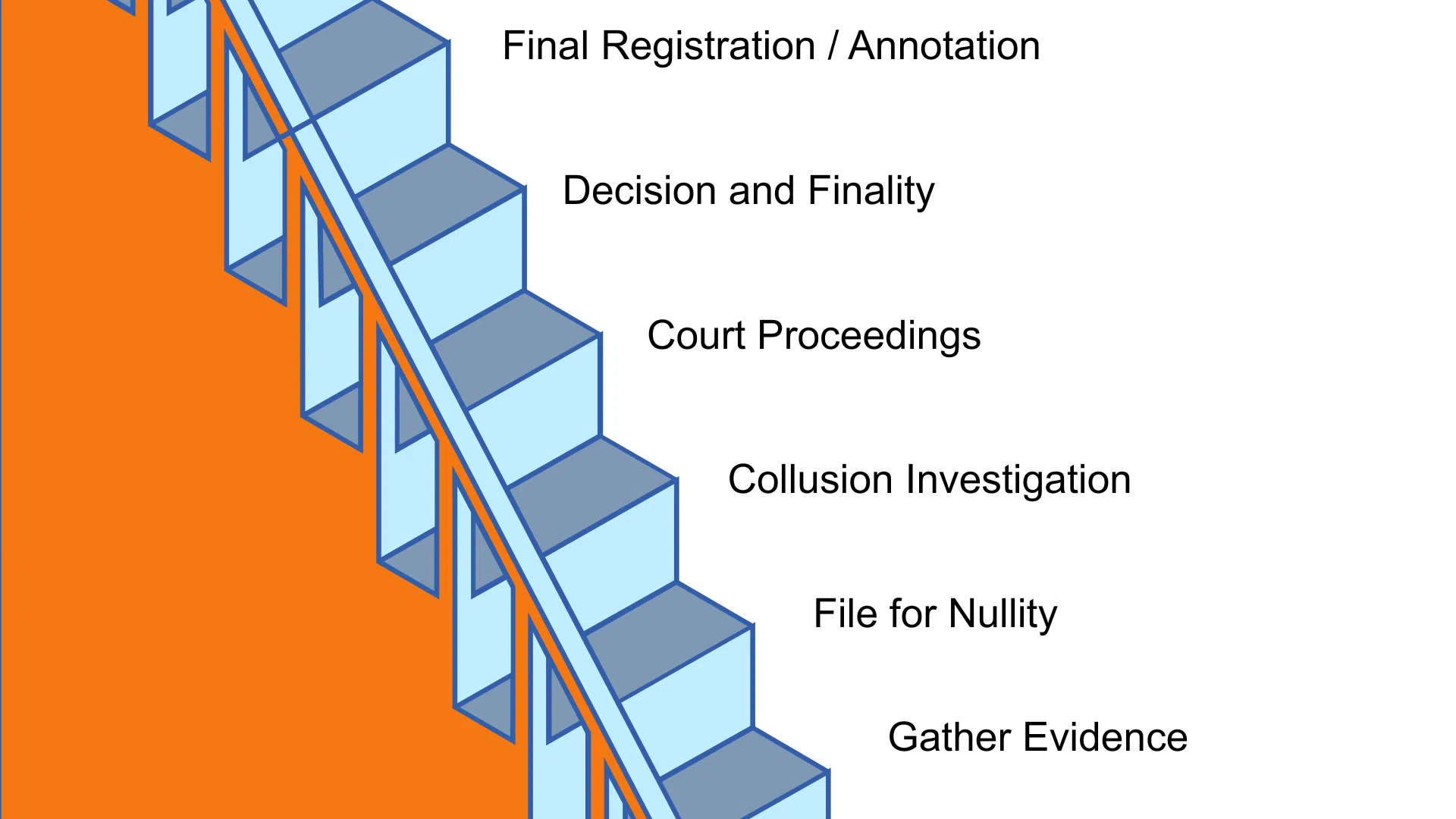
Ending a bigamous marriage requires court proof, hearings, and PSA annotation for records.
All these will need to be presented in court together with witnesses to testify to them and the circumstances of the marriages. If the court rules favorably, its decision will declare the nullity of the marriage.
Steps to end a bigamous marriage (declaration of nullity)
- Gather Evidence
Compile all relevant documents, including marriage certificates and residency proof. A lawyer will most likely also request an Advisory on Marriages for the bigamous spouse. If the person used multiple names, a document linking both identities may be needed. - File for Nullity
Submit a petition through a lawyer for a declaration of nullity at the proper Family Court/RTC branch and comply with residency prerequisites. - Collusion Investigation / Prosecutor Participation (as applicable)
Complete required steps to show there is no collusion and that the case is being tried properly. - Court Proceedings
Attend hearings where evidence is presented and witnesses testify. This can take several months because settings are often spaced out. - Decision and Finality
If the judge is satisfied that the marriage was contracted while another marriage was still existing, the court issues a decision. You typically need to wait for finality before annotation/registration. - Final Registration / Annotation
Register the final decree/decision with the Local Civil Registrar and coordinate PSA annotation so your records reflect the court outcome.
Action: Ask your lawyer for a written checklist of what must be filed, what must be served, and what must be annotated—then track each item with dates.
 Nullity cases can take quite some time—crowded courts, delays, and strict rules slow progress.
The process can take about 3 years, from filing to decision, depending on court calendars, completeness of service, availability of witnesses, and whether the case is opposed.
- Courts are crowded; hearings can be months apart.
- Service requirements and document corrections add time.
- Identity issues (aliases, multiple records) often cause delays.
- There may be difficulty arranging witness testimony with can cause delays.
- There may be stringent requirements set by the judge or prosecutor that is very strict and can cause additional hearings
Action: Ensure that you have your documents in order and ensure that you have

Bigamy cases become complicated because of documents, identity issues, and contradictions.
Bigamy cases are often “simple in theory, messy in documents.” The usual weak points are identity, missing records, and contradictions.
- Multiple names / aliases: You may need additional documents that link identities (same person, different records). This might include DNA tests.
- Missing PSA entries: Sometimes marriages are not easily retrievable; you may need LCR records and certified copies.
- Inconsistent dates/places: These inconsistencies can be exploited if the case is opposed.
- Criminal exposure concerns: If the fact pattern suggests possible bigamy prosecution, strategy matters.
Action: Before filing anything, request and compare: PSA marriage certificate, LCR copy (if available), and the Advisory on Marriages—then highlight mismatches.

The Supreme Court has explained bigamy cases related issues.
Court rulings help clarify what you can—and cannot—do in bigamy-related situations.
- Standing to file (bigamous marriage): The Supreme Court has ruled (in a bigamy-related nullity context) that the ability to file may depend on whether the petitioner is the injured/innocent spouse, not the spouse “guilty” of contracting the bigamous marriage.
- Void marriage defenses in criminal bigamy: Legal literature and case discussions reflect that voidness of marriages can be material in a bigamy prosecution, depending on proof and circumstances.
- Evidence of knowledge and participation: Bigamy cases can involve not only the spouse who remarried, but also allegations about the second spouse’s knowledge—facts and evidence are crucial.
Action: If you’re researching online, search using the G.R. number and compare multiple sources—don’t rely on social media summaries alone.

Secure proof before taking actions in bigamy cases.
Start with documents, not confrontation. The most common mistake is escalating the conflict before securing proof.
- Request PSA marriage certificates and (when appropriate) an Advisory on Marriages.
- Secure your own IDs, your children’s documents, and proof of residence.
- Avoid signing “settlement” papers or waivers without understanding property/child implications.
Action: Make a “document request plan” for the next 7 days (PSA requests, LCR requests, barangay certificate if needed), and complete it before any major confrontation.
If you want a careful legal assessment and a filing strategy, email: admin@lawyerphilippines.org